Welcome To The Deuce
Showing posts with label Korean Cinema. Show all posts

Sunday, November 21, 2010

The Loner (2008)


The Korean horror genre is a love-it or hate-it affair for most, their reliance on black-haired ghosties got old 10 years ago; but they seem intent on further including them in their genre films. Few horror films stray from the formula set-up by break-out Korean horror Whispering Corridors in 1998; schoolgirls being haunted by a dead friend. Those that have strayed from the path have been greatly rewarded (Tales of Two Sisters, Acacia and Save the Green Planet spring to mind) but there are others that remain under-appreciated, such as Black House, Epitaph and Possessed (A.k.a Living Death) three such films deserving of more attention from Horror fans. The Loner however, tries it’s hardest to be different and manages to succeed… for the most part.

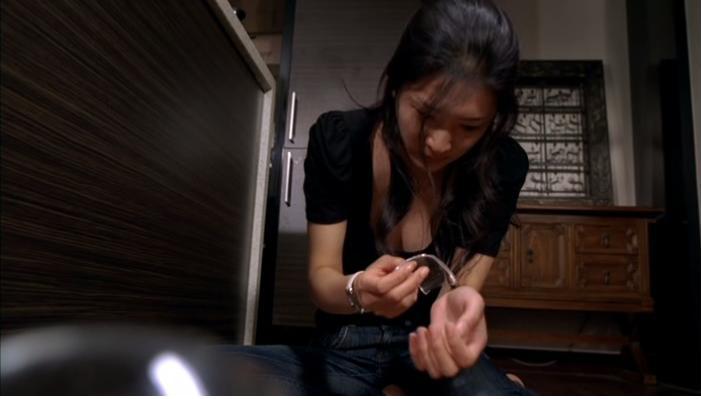
Life is tough for Su-na, her best friend kills herself after a humiliating public beat-down and her Uncle, Se-jin, is in love with Yoon-mi, a psychiatrist she can’t stand. The pressure drives Su-na into reclusion, or as her Uncle's missus calls it ‘Hikikomori’ – a Japanese term for shut-ins. As Su-na’s condition worsens, an imaginary friend and totally disregard for her own hygiene; it appears that Su-na is destined for the same fate as her friend unless Yoon-mi can help get to the bottom of her condition before her condition takes a violent turn not just for Su-na, but the whole household.


Where The Loner succeeds is where other genre entries have failed; is in its characterisation. The film is smartly paced and allows character development to mature naturally, Su-na’s condition doesn’t kick-in until the half-hour mark, that’s not to say its slow paced, as it’s far from it and there’s plenty going on within the narrative to keep viewers entertained as well as a few nasty shocks up its sleeve along the way. There’s obviously a big secret being kept from us, but it’s not hard to guess what it is, but thanks to the story revolving around three protagonists instead of one; the emotional level of the reveal hits harder than it would have if Su-na had been the story’s sole protagonist.


This is where the film eventually falls down. After the big reveal the films gets lost in itself and the final sprint to the ending feels exactly that; rushed. It’s not bad enough to ruin what happens before it, but with a little more thought on the finale maybe The Loner could have been a special little shocker, as is though it’s a worthwhile entry in an already uneven canon. Korean horror certainly has potential and maybe sometime soon we’ll see more classics in the vein of Tale of Two Sisters and Black House. Director Park Jae-sik shows a flare for some lush visuals and has a talent for creating a distressing atmosphere which points to a talent that may well go on to make something far superior to what’s seen here.


It’s disappointing that such a strong film manages to fumble the ball in the final third, but for fans of Korean horror this is well worth checking out. If you enjoyed other middle-tier genre entries like The Wig, A.P.T and Death Bell then you’ll find yourself entertained for the films duration, though the likelihood of frequent re-visits is unlikely; which is a shame as the first half of the film really is gripping stuff. Maybe next time Mr. Park; I for one will be interested in this directors future projects.


Sadly, The Loner is now out of print and has not been acquired for UK or US distribution as yet.

Monday, October 4, 2010

Beautiful (2008)


Kim Ki-duk has always shown a questionable attitude towards women in his movies, which tends to be blown way out or proportion with the majority of his critics; seeing as men are portrayed in a worse light in the films that are blasted as misogynistic. However, he seems to have out Kim Ki-duk’d himself with Beautiful, a film so bleak and misanthropic that it’ll leave most viewers as suicidal and depressed as the characters within the film! It’s also one of the finest slices of idiosyncratic cinema to come out of South Korea since Kim’s Bad Guy.

Eun-yeong (Cha Soo-yeon) is haunted by her beauty, men can’t resist her and woman won’t trust her. The unwanted attention she receives from men reaches it fever-pitch with Seong-min (Kim Min-soo), a stalker who can not control himself around her and violently attacks and rapes her when she refuses his flowers. Destroyed after the incident, Eun-yeong tries to ruin her looks by gouging out on junk food in a bid to become ugly. When this doesn’t work she changes tact and refuses to eat and doesn’t stop working out, eventually forcing anorexia and bulimia upon herself. A policeman, Eun-cheol (Lee Chun-hee), watches as this woman slips further down a spiral of self destruction and eventually becomes obsessed with her.  As her behaviour becomes increasingly more erratic and violent, he decides to take action.


As you can tell from the premise, not much happiness abounds in Beautiful and it’s a better film for it. Not many films are this hell-bent on destroying its audience. This rivals Kim’s previous effort like Bad Guy, Address Unknown and The Isle in the nihilism stakes but also manages to be thoroughly engaging; especially with the performance turned in by lead actress Cha Soo-yeon, which is truly devastating. Lee Chun-hee also proves a quality counter for Cha, whose mental deterioration isn’t as devastating but is equally as disquieting. As the finale once it arrives, it’s a triple-whammy of gut punches that will shock, astound and have you applauding for the sheer balls of the filmmakers or will leave you completely ruined and in need of a hard drink.


This brazen style of filmmaking is what attracted me to Kim Ki-duk, and it’s been lacking in his movies since The Bow. It’s great to see other filmmakers tackling his material and when a talent as bold as Jeon Jae-hong is behind the camera; it’s a privilege to watch the film, and characters, unfold regardless of how dark the film gets. This is cinema at its bleakest, this doesn’t mean its unwatchable but it certainly powerful enough to leave you haunted after watching, those in a frail state of mind should avoid this like the plague until they’re ready to go where the film dares to take them. It’s not a pretty ride, but it’s a journey well worth takind and Jeon Jae-hong just might be the new infant terrible for South Korean cinema, I hope he gets the chance to follow-up on the overflowing potential he shows here.


Unfortunately Beautiful does not yet have a UK release.

Modern Masterpieces #3: Happy End (2000)


I’ve been championing Jeong Ji-woo’s phenomenal film, Happy End, for sometime now (See an old review here) and it’s, tragically, still an underappreciated classic waiting for discovery. Granted, I’ve not sold my girlfriend into the sex industry in order to fund this films release outside of Asia (sorry folks), and as of writing Happy End still hasn't been picked up for UK distribution! With labels folding left right and centre after releasing any schlock to come form the orient with some blood and maybe some nudity, to think that Happy End remains elusive is starting to prove insulting.

Not only is it one of the finest movies of the past decade, but also one of the key films in the Korean new-wave movement which started to emerge in the late 90’s. It stars some of South Korea’s biggest names, with instant recognition for both Oldboy’s Choi Min-sik and prestigious actress, and Cannes-winner, Jeon Do-yeon (The Housemaid) in early, but career launching, roles as the husband and wife of the story. Mo Ju-jin is also no stranger to fans of Korean cinema, with his roles in art-house fare like Kim Ki-duk’s Real Fiction and blockbusters like Musa: The Warrior rounding out the main cast and giving his best performance to date here.


Bo-ra (Jeon) is having an affair with college sweetheart, Kim (Mo). Her relationship with husband Seo (Choi) is lifeless, seemingly in existence to provide for their new born daughter. Seo becomes aware of his wife’s infidelity but is contempt with the situation; as long as they stay together and raise their child he’s willing to turn the other cheek. However an unfortunate accident leaves the infant hospitalised and this infuriates Seo, as a result he becomes determined on putting an end to his wife’s affair.


What elevates Happy End out of your typical melodrama tedium is the superb, scratch that, it’s the exquisite characterisation found within the script and the performers willing to launch body and soul into their respective roles. Normal melodrama is a chore to sit through, with directors relying on over the top incidents and awful musical cues to provoke the desired reaction the story cannot delivery organically. However, with Happy End Jeong Ji-woo doesn’t need to rely on external elements to provoke his desired reaction form the audience; the story development is of such a standard that you understand all three characters and can understand why they act the way they do: be it Bo-ra’s desire for passion, Kim’s infatuation or Seo’s belief in family unity. You will not agree with their actions at times, but you’ll understand the reasons behind them; which is what makes the film all the more horrific as the film careens towards its devastating finale.


With a market that has been flooded by all sorts of trash from the Far East, it remains a mystery that such a bold, daring, and genuinely fantastic, film such as Happy End remains the elusive omission for fans of well developed adult material. Despite the films success at the 2000 Cannes film festival and the stars this films boasts, it’s frankly baffling why this remains without distribution here in the United Kingdom: fingers need pulling from rectal cavities and Happy End deserves to find its British audience.


Unfortunately Happy End does not yet have a UK release.

Tuesday, September 21, 2010

Modern Masterpieces #1: Sympathy for Mr. Vengeance (2003)


Chan-Wook Park is one of the great directors working in film today, that’s not hyperbole or fan-boy hype, it’s a fact. With only a handful of films, he’s managed to launch a career that has raised the global profile of not just his work, but his actors and the South Korean industry as a whole. He’s one of three director’s working in South Korea today that continues to generate international buzz in film magazines and websites; the other two being Bong-Joon Ho (The Host) and Ji-Woon Kim (Bittersweet Life). I first became aware of Park in 2002 with JSA: Joint Security Area, I was still relatively new to Korean film and JSA was a great example of what the country was capable of producing, but then I watched Park’s follow-up, Sympathy for Mr. Vengeance early in 2003 and it truly changed the way I viewed movies.

The story is simple, or so it seems. Ryu (Shin Kyun-ha), a deaf mute is knocked-off by black market organ dealers when he attempts to buy a new kidney for his terminally ill sister. Needing cash quick in order to pay for a legitimate transplant, he devises a plan with his anarchist girlfriend (Bae Doo-na) to kidnap his ex-employers (Song Kang-ho) daughter and hold her for ransom. Naturally, the plan doesn’t go as planned. To divulge more would be criminal to those who have not seen the film, needless to say it gets bloody.


With the financial success of JSA, Park was given creative freedom for his next project, and it shows. JSA was a big production, a blockbuster movie that broke box-office records; many were expecting another such production with Mr. Vengeance. How wrong they were. Mr. Vengeance is so far removed from JSA that it’s remarkable they came from the same person; JSA was a visually striking movie, but in a glossy, MTV fashion that he would later take to his extreme with 2004’s Oldboy. Mr. Vengeance couldn’t have been more different, stripped down to film minimum; Park relies only on the story and actors to wow over his audience: there’s no music, no elaborate set-pieces and no clever twists here, only an oncoming car crash of a narrative that you can’t divert your stare from.


With this bold stylistic decision also comes alienation. The films purposeful cold metallic palette echoes the characters mental anguish which leads to the numerous bloody encounters within the film, but to the casual viewer it may be too much of an extreme; the film drips negativity and is filmed with a documentary-like realism that will disturb and punish more than thrill and excite. This came at a time when South Korean cinema was very much style over substance for the most part, with movies like Shiri and Tell Me Something wowing audiences with their looks rather than their story. This stripped-down, nihilist approach can also be responsible for the films poor performance at the box-office in its home country.


More akin with fellow Korean enfant terrible, Kim Ki-duk’s filmography than anything else Chan has produced, Sympathy for Mr. Vengeance remains one of South Korea’s greatest achievements. It may not have won as many awards as his later films or made as much bank, but in twenty years time this is the film that most will be looking back at and re-visiting to understand Park the film-maker. Here is where his dark heart emerged; this is his first cruel ode to cinema and remains arguably his finest achievement to date. A film that broke all the rules, not just onscreen but off, it’s the product of a man who truly defied, and smashed, every expectation laid upon him to produce something spectacular. Love it or hate it, Sympathy for Mr. Vengeance will leave a scar upon you that will never be removed.


You can buy Sympathy for Mr. Vengeance on Blu-ray of DVD now.

The Housemaid (2010)


Im Sang-soo is no stranger to controversy in his native South Korea. With films like Tears and The Presidents Last Bang landing the director in hot water for their depiction of teenage sexuality (Tears) and a blasting depiction of Politicians (Presidents Last Bang). So you can rely on the man for shock value, as well his strong visual style of story telling. With his latest release The Housemaid, he’s produced the most sexually explicit mainstream film to have come out of his homeland…

Eun Yi (Jeon Do-yeon), is hired as a nanny/maid for a disgustingly rich family who are expecting twins. The mother (Seo Woo) is due to deliver within weeks of Eun Yi’s employment so Eun Yi takes care of their first born, Nami (Ahn Seo-hyeon) while the mother worries about her figure. The husband (Lee Jeong-jae) is smitten by the new maid and it isn’t long before he’s moving in on her. An affair is sparked and when news that Eun Yi is pregnant breaks, it threatens to not just destroy their relationship, but will affect all of those within the household.


The first thing that grabs the viewers’ attention is Im Sang-soo’s glorious visual style. Each frame is a composition to be marvelled, a shot as simple as a man in a hallway has never, and should never look as beautiful – decadent in fact – as it does here. Each frame is a loving composition that leaves the viewer in awe. You could say that Sang-soo is using these exquisite visuals to hide the films flaws, which is a valid point as the film does have its issues with its rushed finale; but the visuals are essential to the film not just for aesthetics, but it helps us fall in love with the world that Eun-yi herself becomes infatuated with.


The Housemaid is a slow-burner, very little actually happens, its narrative progression is through dialogue and not set-pieces. Character actions are witnessed, but the consequences for these actions are escalated through dialogue driven confrontations which gradually builds and builds until the film literally explodes in the finale. This is the films biggest flaw, the pay-off is built-up throughout the film, yet the finale does come across as rushed. It’s the only flaw the film has, but if you’re caught up in the movies spell, which is hard not to be, it’s forgivable but others may be left disappointed.


The actors are all on form here, with Jeon Do-yeon giving a no-holds barred performance that has seen her rightly rewarded with various accolades on the festival circuit. Lee Jeong-jae also delivers a fantastic performance as a man who has it all and believes he’s entitled to everything within his household regardless of others feelings; he’s a detestable fella, yet his charisma is hard to deny; witness his Patrick Bateman-esque sexual prowess and try and hold a grudge against him.


The Housemaid may not be the masterpiece the original 1960’s version is, but as an erotic thriller the film ranks as one of the genre’s finest. A movie that is truly titillating and thrilling, the film excels with its visual-seduction as the characters sweat the screen up. It may be too slow for most, but for those with patience and appreciation for beautiful compositions and a sold story, there is plenty here to appreciate. It’s bold film and one of South Korea’s best of 2010.


You can buy the Korean DVD for The Housemaid here.